
Or how to turn a 100-watt amplifier into a frequency blender.
You've bought a seven-string guitar, installed high-output pickups, spent three nights researching the Meshuggah guitar tone, and finally found a preset that promises to bring down the concrete walls of your apartment building.
The first palm mute is glorious.
You feel personally responsible for the extinction of the dinosaurs.
Then the bass and drums come in.
Where did the guitar go?
You turn up the gain. Turn up the volume. Add more bass. Open another plugin. Buy another impulse response.
Three hours later, your guitar still sounds small, but you have enough plugins to open your own branch of Plugin Alliance.
What happened?
The side effect of playing guitar alone
As a guitarist, I understand this obsession perfectly.
There's something incredibly satisfying about playing through a tube amplifier, feeling the cabinet vibrate and hearing that enormous low end fill the room.
The trouble is that we're judging a guitar as if it were the entire band.
When we play alone, we want lows, mids, highs, sustain, depth and the feeling that something catastrophic is about to happen.
The only thing we haven't asked the amp to do is play bass, drums and sing backing vocals.
In a music production, that tone has to share space with other instruments. And the beautiful sound you found on your own may not work the same way in the arrangement.
Not necessarily because it's a bad tone.
Maybe it's trying to do too much.
Gain is a great employee. A terrible boss.
Distortion is part of the language of metal. I'm not here to convince anyone to record deathcore through the clean channel of a Fender Twin.
You can put the pitchforks away.
Gain increases saturation, changes harmonic content and can extend the perceived sustain. Depending on the circuit and how hard it's driven, it can also reduce the dynamic contrast in a performance.
That's where we need to pay attention.
Imagine a riff with fast picking, rests, shifting accents and palm mutes.
Each of these elements communicates something to the listener. When saturation begins to hide those differences, some of the musical intention can disappear.
You're still playing every note.
The problem is that some of them have moved in together.
And nobody knows who's paying the rent.
In certain arrangements, backing off the gain a little can bring definition, articulation and aggression back to the riff.
In others, extreme saturation is exactly what the song needs.
The secret isn't the position of the knob. It's hearing what happens when you turn it.
The bassist would like a word
There's an interesting experiment every metal guitarist should try.
Choose a heavy song you admire and focus exclusively on the bass.
Now imagine the same song without it.
Much of that wall of sound you could have sworn was coming from the guitars probably wouldn't exist in the same way.
Bass supports the low end, adds harmonic texture, follows the articulation of the guitars and establishes a rhythmic relationship with the drums.
In many modern metal productions, it's precisely this combination that creates the impression of an enormous guitar sound.
It's practically a sonic real estate scam.
You thought you bought an eight-string guitar, but half the property belongs to the bass player.
That doesn't mean we should remove every low frequency from the guitars and hand the entire region over to the bass. That would be another oversimplification.
What matters is understanding how these instruments complement each other.
A guitar with less low end may sound heavier in one arrangement. In another, removing those same frequencies could completely destroy the aesthetic of the song.
Context decides.
The graveyard of forbidden frequencies
If you watch mixing tutorials, you've probably come across a chart explaining which frequencies should be removed from guitars.
Watch out for 250 Hz.
Clean up the mud at 400 Hz.
Cut the harshness at 3 kHz.
Do this. Do that.
By the time you've followed every recommendation, your guitar is acoustically sanitized, socially acceptable and completely incapable of frightening a five-year-old.
There are no criminal frequencies.
There can be too much, too little, masking and, above all, artistic intention.
The frequency range that compromises definition in one production may be precisely what gives the guitar its body in another.
A frequency that sounds unpleasant in isolation may be exactly what allows an instrument to cut through a dense mix.
An equalizer is a fantastic tool.
But it doesn't know your song.
Before removing a frequency, we need to understand whether it's actually getting in the way.
Seven strings, eight strings and a minor existential crisis
I like low-tuned guitars. I own six, seven and eight-string instruments precisely because each offers different possibilities for composition and expression.
But there's an interesting challenge when you enter that world.
The lower we tune, the more attention we need to pay to the relationship between performance, string tension, amplifier response and note definition.
A guitar in Drop E doesn't necessarily need more bass on the amplifier.
In certain situations, what it needs is better control over that region, especially before saturation.
That's one reason an overdrive in front of a high-gain amplifier can work so well. It's not just about additional gain, but about how it changes the signal reaching the distortion circuit.
Still, there's no obligation to use a Tube Screamer, a boost or any other particular tool.
If the guitar already responds the way you need it to, why fix a problem that doesn't exist?
Six amplifiers and no definitive answer
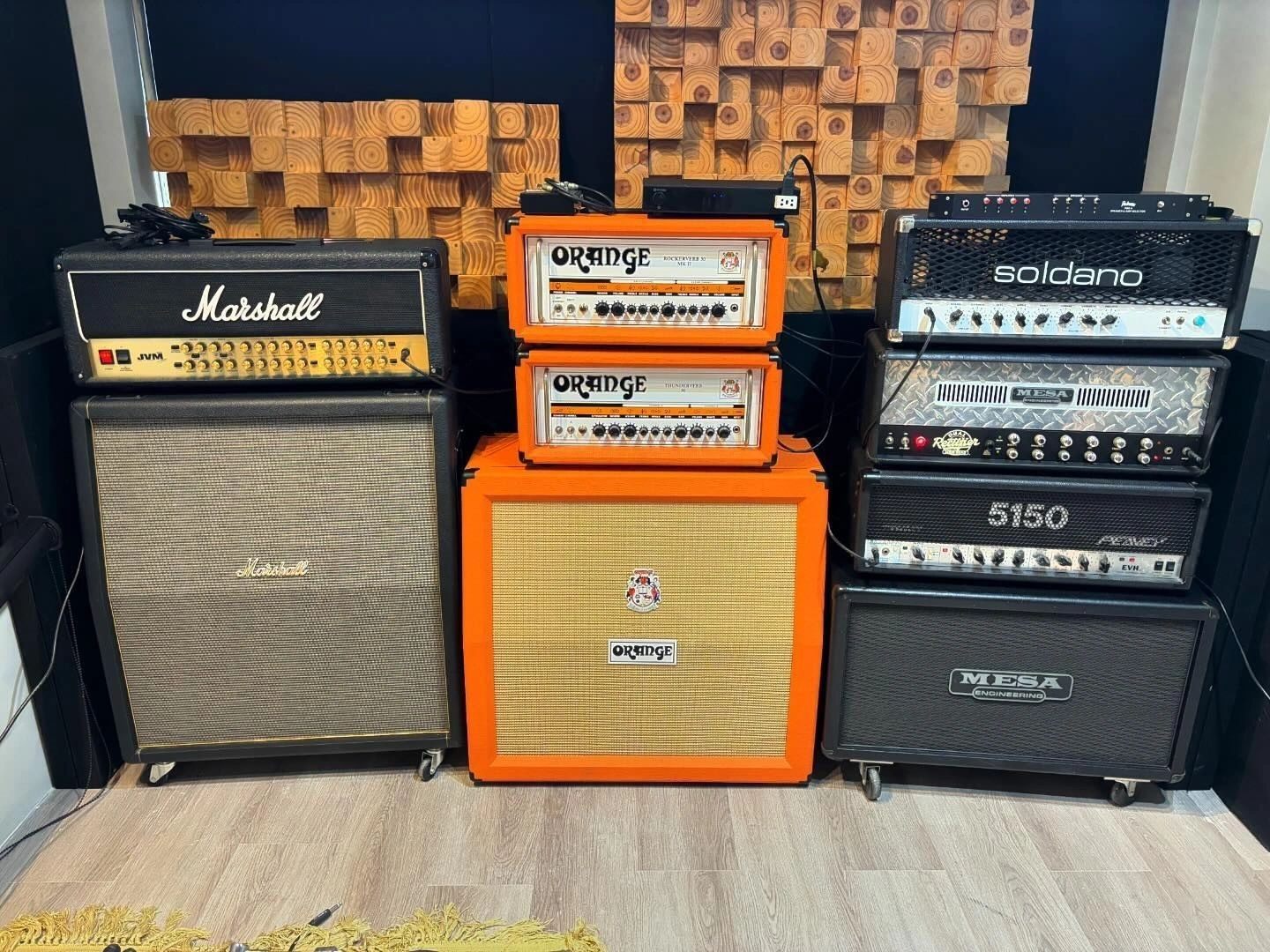
At Static Progress Studio, I have access to amplifiers with very different personalities:
- Peavey 5150 Block Letter.
- Mesa Boogie Dual Rectifier Rev G.
- Soldano Hot Rod 50+.
- Marshall JVM410H.
- Orange Thunderverb 50.
- Orange Rockerverb 50.
Which one is best for metal?
It depends.
I know. It's the most irritating answer a music producer can give, especially after spending that much money on amplifiers.
But consider this: the same riff might call for the aggression of a 5150, the breadth of a Dual Rectifier or the distinctive texture of an Orange.
The choice depends on the performance, arrangement, cabinet, speakers, microphone placement and the aesthetic the artist is aiming for.
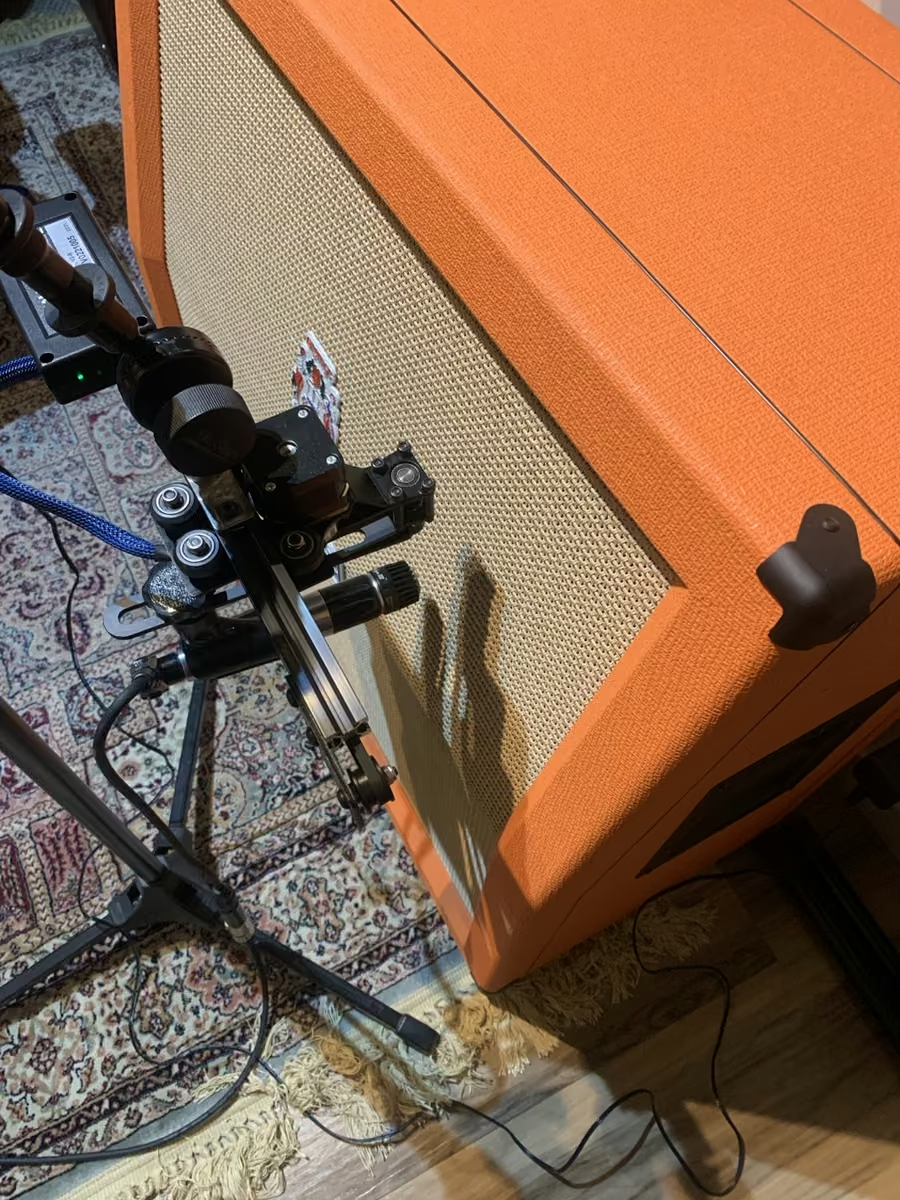
Gear matters. Otherwise, I would have invested that money in a wine collection and probably had a lot more space in the studio.
But owning different tools doesn't mean using them indiscriminately.
It means having alternatives so you can make better decisions.
Reamping: when you can argue with the amplifier instead of the guitarist
One of the great advantages of recording a DI signal is the ability to separate the performance from the final tone decision.
With the Creation Audio Labs MW1 and the conversion system at Static Progress Studio, we can preserve the original performance and send it to different amplifiers later.
That allows us to compare tones using exactly the same performance.
We can adjust gain, try different cabinets, change microphone placement and listen to how each decision affects the song.
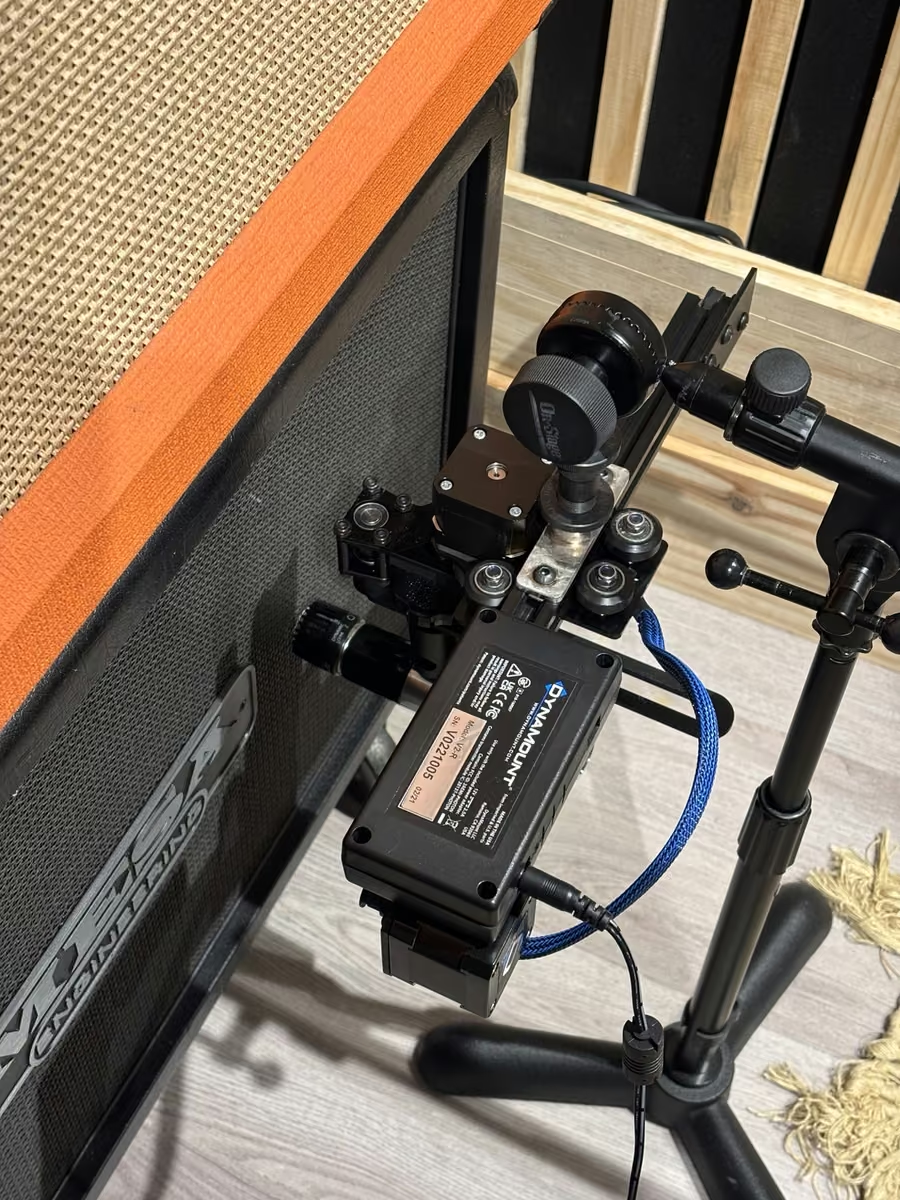
Without asking the guitarist to record that impossible riff for the forty-third time.
But there's a crucial detail in this comparison: match the perceived loudness as closely as possible.
A slightly louder tone can seem better simply because it's louder.
And it's easy to confuse volume with quality, particularly when we're in love with the sound.
Try this experiment before buying another plugin
The next time you're producing a heavy song, try this:
- Record a riff containing palm mutes, chords and rests.
- Use the same DI to try three different amounts of gain.
- Match the perceived loudness of the versions as closely as possible.
- Listen to each one with the bass and drums.
- Notice which version communicates the riff's intention most effectively.
Don't necessarily look for the prettiest, most aggressive or most impressive tone in isolation.
Look for the tone that makes the song work.
Maybe it's the one with less gain.
Maybe it's the most saturated.
The point of this exercise is to develop the ability to recognize the difference and understand why a particular choice works.
That skill will still be useful when all your favorite plugins have been replaced by new versions, now with artificial intelligence, a three-dimensional interface and a monthly subscription you'll forget to cancel.
So where does heaviness come from?
Heaviness emerges from the relationship between composition, performance, tone, dynamics and contrast.
A well-executed pause can make the next chord much more aggressive.
Drums that follow the intention of a riff can completely transform the way you perceive it.
A well-crafted bass part can give the guitars a dimension they could hardly achieve on their own.
The amplifier plays a part in all of this. But it shouldn't have to carry that responsibility alone.
Producing music means understanding these relationships and deciding which ones deserve emphasis.
That's why, before looking for a new tone, I like to understand what the music is trying to communicate.
In the end, the listener won't ask how much gain was on your amplifier.
They'll remember how they felt when that riff came in.
And that's what interests me.
Juan Otero
Static Progress Studio
Digital Sonora
Sound with identity. Sound with legacy.