
There's a curious phenomenon in the audio world.
A guy spends ten years complaining that professional gear is too expensive.
Then a Brazilian company builds a preamp inspired by an American classic.
And the first question is:
“But is it actually any good?”
Interesting.
If it had an American flag stamped on the front panel, the question would probably be which credit card allows 24 monthly installments.
Does the name matter more than the sound?
Anyone who works in music production knows the names.
API, Neve, SSL.
Three letters here, four letters there, and suddenly the price starts looking like a mortgage.
I'm not saying those manufacturers don't deserve their reputations. They do.
The question is something else.
When did we start judging preamp quality by the country where it was made?
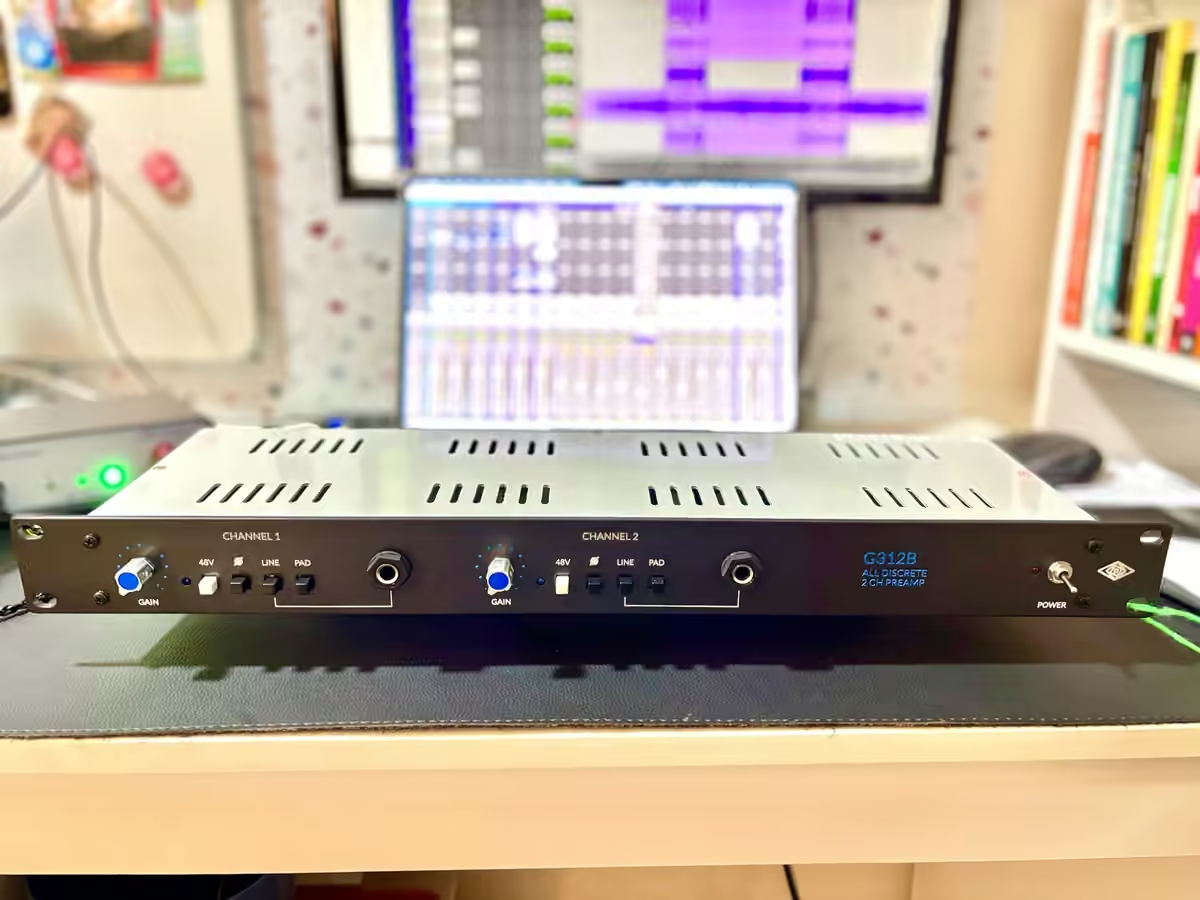
That's part of why I decided to make room for the Greenbox G312B at Static Progress Studio.
A Brazilian preamp that's not trying to reinvent the wheel.
It's trying to make that wheel spin exceptionally well.
What's inside this box?
The G312B draws on the classic API 312 design, an architecture that helped shape the sound of countless recordings.
It has two independent channels, fully discrete circuitry, and transformers at the input and output of each channel.
Four transformers.
And not one of them was installed just to make an Instagram photo look better.
The idea is tight low end, present mids, fast transient response and a healthy dose of character.
But there's one word that absolutely belongs in this conversation.
PUNCH.
The API punch: when sound doesn't knock before coming in
If you've worked with the classic API preamp sound, you know the discussion goes beyond frequency response.
There's a sense of impact.
A snare that seems to jump out of the speakers.
A kick with attack that doesn't require turning your session into an EQ competition.
A tom that arrives with authority, claims its space, and leaves before it gets annoying.
That's the famous punch associated with API-style architecture.
And we're not simply talking about more volume.
Volume makes the hit louder. Punch makes you feel the instant it lands.
Sounds like the same thing.
It isn't.
A recording can be loud and still feel completely lifeless.
It's like someone screaming through an argument without actually saying anything.
Plenty of noise.
Not a single point.
Punch involves preserving the initial attack, dynamic behavior, midrange character and the way a circuit responds to transients.
That's the philosophy that makes the G312B so interesting.
A preamp based on the API 312 concept, made in Brazil, aiming for that combination of presence and impact.
Drums don't want to be polite. They want to be heard.
Think about recording a snare drum.
There's the moment the stick hits the head, the body of the drum, and the decay that follows.
Those are different events, even though they happen almost at once.
A preamp with a fast, well-controlled transient response can help preserve that articulation.
In practice, that's exactly what I look for when I want drums that are aggressive but still defined.
I'm not just interested in recording a pretty snare.
I want to record a snare that has something to say.
Preferably something the neighbors would find deeply offensive.
The same applies to toms, kick drums and guitars.
In modern metal, where dozens of elements fight for room in a mix, a well-defined attack can matter more than simply adding bass or treble.
Because heaviness without definition isn't necessarily aggression.
Sometimes it's just a traffic jam.
And nobody needs another traffic jam.
Especially not inside Pro Tools.
But does it sound exactly like an API?
It's the inevitable question.
And perhaps the least interesting one.
The G312B takes inspiration from a classic design. That doesn't mean it's electronically identical to an original API unit, or that the two should sound exactly alike.
A meaningful comparison takes recordings under identical conditions, properly matched levels and critical listening.
I'm not trying to find out whether a Brazilian box can impersonate an American one at a party.
I'm trying to find out what it adds to my recordings.
Whether it brings the attack I'm looking for.
Whether it preserves the intent behind a performance.
And, above all, whether it serves the music.
Life exists before the plugin
I love plugins.
I have so many that, if I opened them all at once, I'd probably need permission from the power company.
But an important decision happens long before the first EQ window appears.
Tracking.
The microphone, positioning, preamp, conversion and performance.
That's where everything begins.
A great preamp won't rescue a drummer who can't play.
And it won't turn an out-of-tune guitar into a Swiss precision instrument.
But it can help a strong performance reach the computer with the dynamics, attack and character it deserves.
And in rock and metal, that matters.
Brazilian isn't a lower-quality category
Perhaps the most interesting thing about the G312B isn't entirely inside its circuitry.
It's the fact that Brazilian manufacturers are building equipment for an industry that spent decades looking almost exclusively abroad.
We don't need to pretend every Brazilian product is amazing.
That would only mean replacing one prejudice with another.
We need to do something much simpler.
Plug it in. Record. Listen. Compare.
No cheerleading.
No compulsory patriotism.
And no assumption that a piece of gear automatically sounds better after clearing customs.
In the end, nobody hears the label
When people listen to a song, they don't know which preamp was used.
They don't know how many transformers are in the rack.
And they probably won't ask whether the circuit was developed in Brazil or the United States.
They feel something.
Or they don't.
And that's still our job.
At Static Progress Studio, equipment doesn't come in to impress visitors.
It comes in to help build a sonic identity.
The Greenbox G312B is now part of that conversation.
Because, at the end of the day, music doesn't need a passport.
But if it has punch, it usually kicks the door open.
Juan Otero, Static Progress Studio
Art + Static Progress = Digital Sonora